
Laminate flooring installation
Harder surface and lower cost, for dry rooms where water is not the concern.
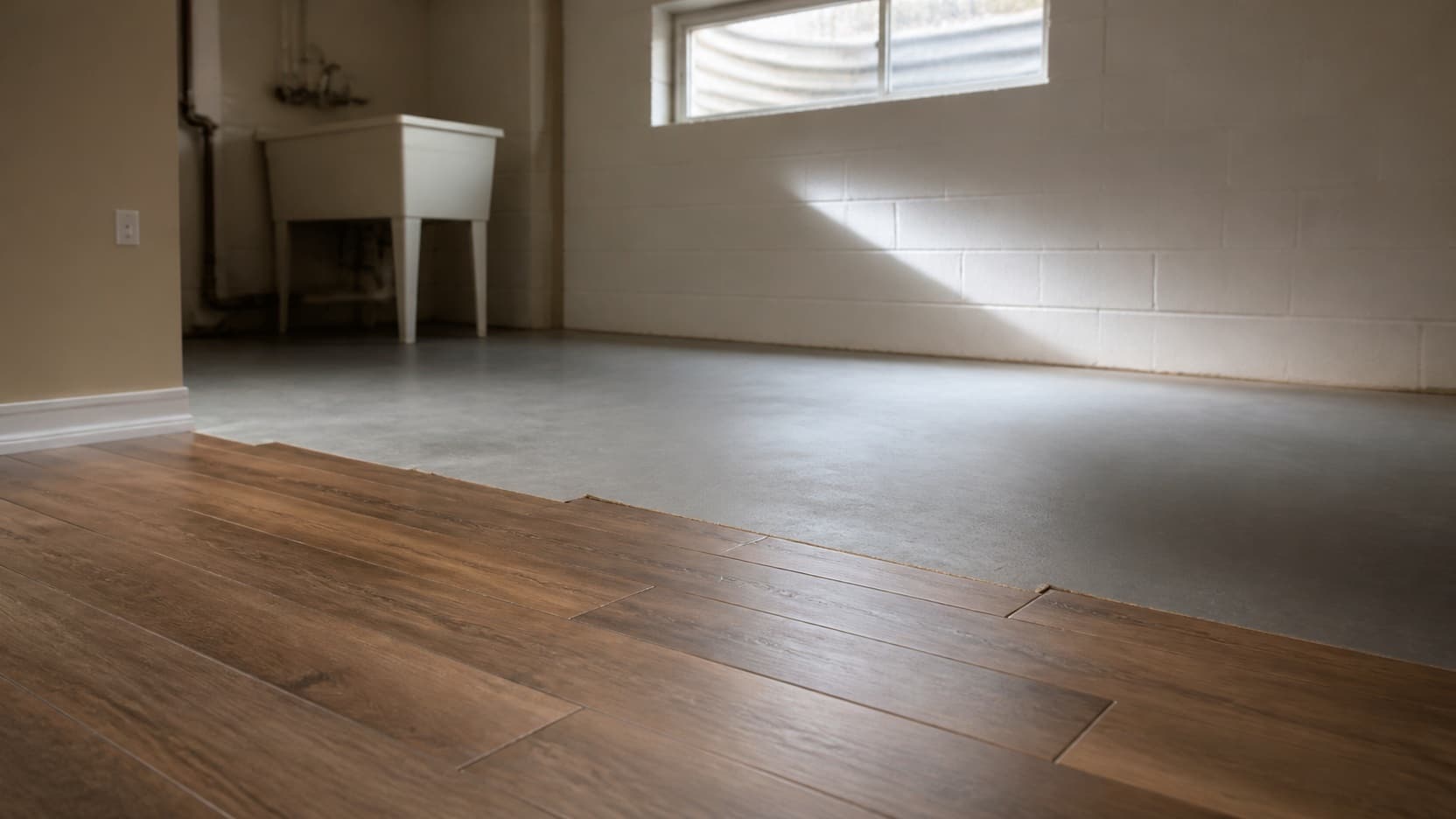
Luxury vinyl plank is waterproof the whole way through, which is why it ends up in basements, kitchens, bathrooms and laundry rooms. In a house with a finished lower level it is usually the only sensible answer.
This is the whole reason the product exists. A luxury vinyl plank has no wood or paper in it. Water sitting on it does nothing, and water sitting on it for a week still does nothing to the plank itself.
That is a real difference rather than a marketing one. Laminate is water resistant on the surface and vulnerable at every joint, because the core behind the joint swells. Wood is wood. Vinyl simply does not care.
It matters here because a large share of Staten Island houses have a finished lower level, and below grade is where floors fail. A basement floor can be fine for years and then meet one appliance failure or one wet spring. Vinyl is what survives that.
The caveat is worth saying plainly: the plank is waterproof, the room is not. Water that gets under a floating floor still has to be dried out, and the subfloor beneath it can still be damaged. Waterproof means the floor itself does not need replacing.
Two ways to fit the same product, and the choice is usually made by the room rather than by preference.
Planks lock at the edges and rest on the subfloor. Quicker to fit, easy to lift a plank later, and forgiving of a subfloor that is sound but not perfect. Wants an expansion gap at every edge, and can move slightly underfoot.
Each plank is bonded to the subfloor. Dead solid underfoot, no expansion gap needed, and it handles temperature swing better, which matters in a room with a lot of glass. It needs a properly flat and clean subfloor, and lifting it later is real work.
Large open areas, rooms that get direct sun, and commercial style use tend to point to glue down. Basements, bedrooms and normal domestic rooms are usually fine floating, and floating is the more common choice in a house.
Over concrete, both need a moisture test first. The reading can rule out an adhesive, which is one of the ways this decision gets made for you.
Over concrete, the honest answer is that the slab decides everything. It gets checked for flatness and for moisture before a product is chosen, not after.
Flatness matters more with vinyl than with almost anything else, because the planks are thin and flexible. They follow whatever is underneath rather than bridging it, so a dip in the slab becomes a visible dip in the floor and a high spot becomes a wear point. Levelling compound is common and it is not a sign that something has gone wrong.
Moisture decides whether an adhesive can be used at all and whether a barrier is needed under a floating floor. In a basement this is the single most important measurement taken all job.
Over a timber subfloor it is simpler. Refasten anything loose, take out the high spots, and make sure the surface is smooth enough that nothing telegraphs through.
Flatness across the whole area and, over concrete, moisture. These two readings choose the fitting method.
Old covering out, adhesive residue removed, low spots levelled and high spots ground down. Over a slab this is most of the labour.
Planks laid with joints staggered and the pattern varied so no repeat is obvious, expansion gaps at the perimeter for a floating floor, or bonded down for a glued one.
Beading or skirting, thresholds where the floor meets something different, and doors trimmed if the height has changed.
Doing a basement? Tell us what is on the slab now and we will tell you what preparation to expect.
Call (929) 207-0785No. Most vinyl plank fitted in houses is click together and floats, which means it is not fixed to the subfloor at all and rests on it instead.
Glue down is the better choice in a few situations: very large open areas, rooms with a lot of direct sun where the floor sees real temperature swing, and anywhere you want it dead solid underfoot with no movement.
Over concrete, a moisture test can make the decision for you, because a slab reading too high rules out an adhesive and points to a floating floor with a barrier under it.
Harder surface and lower cost, for dry rooms where water is not the concern.
Real wood above grade, where the room is dry and stable.
Where water has damaged a wood floor, repairing it may still beat replacing it outright.
Tell us the room and what is under the current floor, and we will talk through what it needs.