
Buff and recoat
If the damage is only in the finish, this refreshes the floor with no sanding, in less time and for less money.
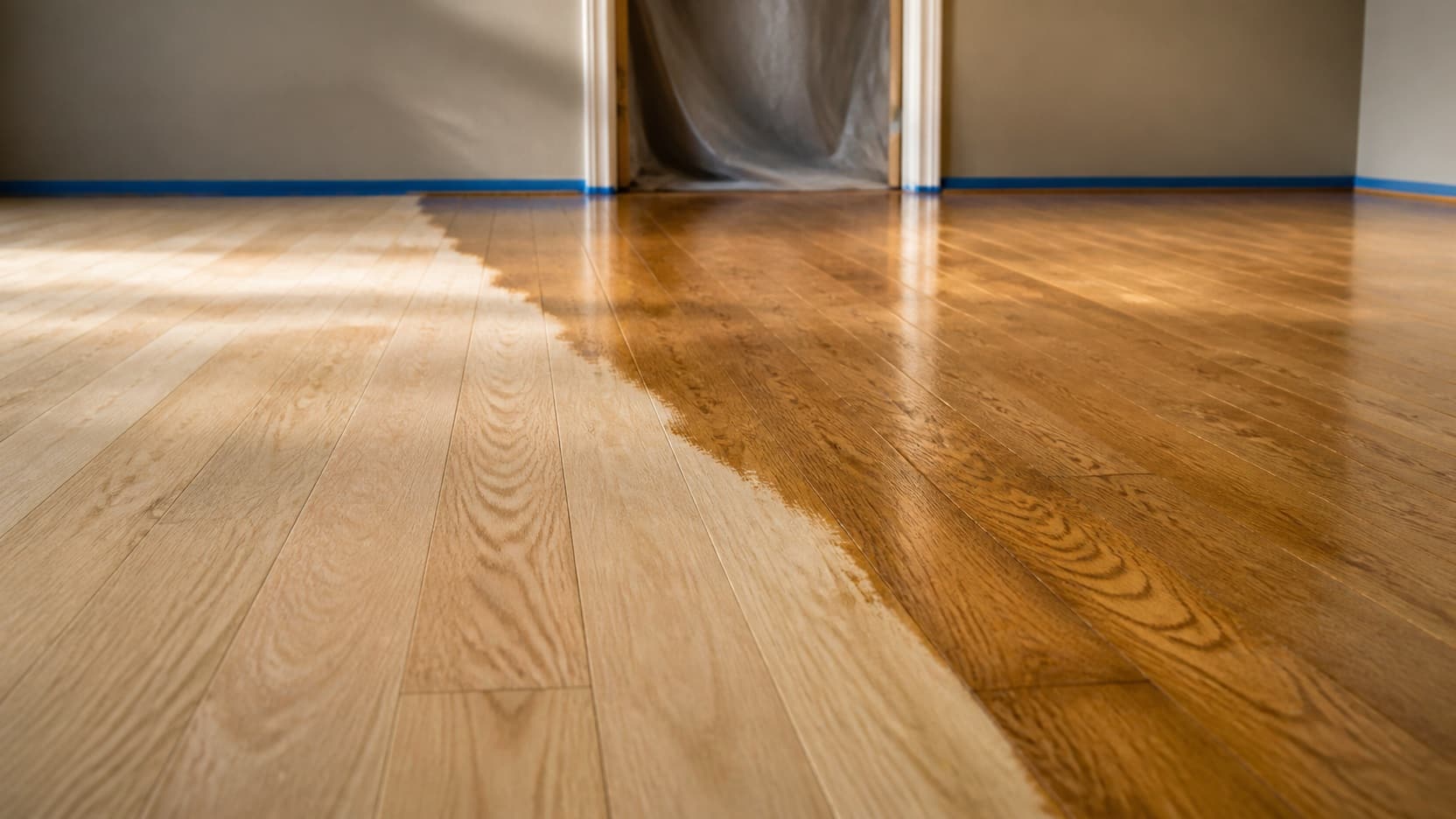
Refinishing takes a hardwood floor you already own back to bare wood and puts a new finish on it. Done properly it resets the floor completely, and the boards you end up with are the ones that were already there.
Every finished wood floor has two parts. There is the wood, and there is the coating sitting on top of it. Refinishing removes the coating and a very thin layer of the wood with it, which takes out the scratches, the grey patches and the worn track down the middle of a hallway, and then puts a new coating on the fresh surface underneath.
That is why a refinished floor looks new rather than clean. Nothing has been covered up. The marks are gone because the wood carrying them has been taken off.
It is also why refinishing is not something a floor can have endlessly. There is a finite amount of wood above the tongue and groove, and each full sand spends some of it.
Two things decide it. How deep the damage goes, and how much wood is left.
Solid wood or a thick engineered board, boards sitting flat and tight, damage that lives in the finish or in the top millimetre or two of wood. Grey traffic paths, scratches, dulled patches and old stain colour all come out.
Loose, split, cupped or water damaged boards. These get repaired before any sanding, because a sander over a loose board makes a dip that no amount of finish hides.
A floor sanded so many times that the nails or the tongue are close to the surface, or a thin veneer engineered board with nothing left to take off. Here the honest answer is a new floor rather than another sand.
This is a judgement made by looking at the floor and at its edges, usually at a threshold or under a radiator where the original thickness still shows. It is not something anyone can decide from a photograph alone.
Sanding is the part everyone pictures. It is one of five stages, and the ones on either side of it are what decide how the floor looks.
Furniture out, doors off where they need to be, vents and doorways sealed. Anything loose or damaged in the floor is fixed now, and old carpet tacks and staples come out.
The first pass takes off the old finish and levels the surface. This is the aggressive stage and it is where an uneven floor either gets flat or does not.
Successively finer passes remove the scratches left by the pass before. Skipping a grit is the most common way a floor ends up looking hazy under the finish, and it only shows once the coating goes on.
Machines cannot reach the perimeter, the corners or the treads, so those are done separately and blended into the main field. On a Staten Island house this is usually a real part of the job rather than a detail.
Colour first if you are changing it, then the finish coats with drying and a light abrasion between them. The last coat is the one that decides the sheen and how the floor wears.
Describe the worst patch and roughly how many square feet, and we will tell you which job you are looking at.
Call (929) 207-0785Area is the obvious one and it is not the interesting one. Two floors of the same size can be very different jobs.
Condition is the first real driver. A sound floor that needs a straightforward sand is the cheap version. Boards that have to be replaced, gaps that need filling, water damage, glue or paint on the surface and old adhesive from a carpet all add work before the sanding can even start.
Access and layout are the second. A clear open floor is quicker than the same area broken into small rooms with closets, because the machines spend more time not cutting. Stairs are priced separately and honestly, because a flight of treads and risers is slow hand work rather than machine work.
The finish is the third. The number of coats, and whether you are staining, change both the material and the number of days the floor has to be left alone.
We do not publish a square foot rate, because a rate quoted without seeing a floor is either padded to cover the worst case or it is a number that changes once somebody arrives. What we will do on the phone is tell you which of those drivers apply to what you have described.
Most Staten Island floor work is in a house rather than a single level, and that makes the staircase part of the conversation whether or not you called about it.
A refinished hallway meeting an untouched staircase is very visible, because the two are in the same eyeline and the colour difference is obvious at the bottom tread. Doing the stairs at the same time costs more on the day and it is usually the right call. Doing them later means matching a finish that has already started to age.
The same is true of a floor that runs from a hall into a living room without a threshold. If the boards are continuous, the job is continuous, and stopping halfway leaves a line that only ever gets more noticeable.
None of that means you have to do everything at once. It means the decision is better made deliberately than discovered at the end.
It depends on area, on the condition of the boards, and on how much work has to happen before the sanding starts. Those three move the number far more than the size of the room does.
We do not publish a rate, because a figure given without seeing the floor is a guess. Tell us the rooms, the rough size and what is wrong with the floor, and we can tell you which of the cost drivers apply to your job before anybody visits.
A solid wood floor has a limited amount of wood above the tongue and groove, and every full sand takes a little of it. How many sands are left depends on the original thickness and on how heavily it has been done before, not on a fixed number.
Engineered boards vary far more. A thick wear layer takes a sand or two, a thin veneer takes none at all.
It is checked by looking at an exposed edge, normally at a threshold or a vent, where the full thickness of the board is visible. If there is not enough left, we will say so rather than take another pass off it.
Less than it used to and more than none. Sanders running on dust extraction capture most of it where it is made, and sealing doorways, vents and returns keeps most of the rest out of the rest of the house.
Fine dust still settles, particularly in the room being worked on, and there is usually a clean down afterwards. Anybody promising a completely dustless sand is describing something that does not happen.
Usually yes, if the work is being done in sections. We seal off what is being worked on and leave you a way through the rest of the house, and the rooms come back to you as they are finished.
It is harder when a whole floor goes at once, and hardest during the finishing coats, which need to be left alone and which have a smell while they cure. Some people stay through it and some prefer to be out for a couple of nights. It is worth deciding before the work starts rather than during it.
Yes, and on most Staten Island houses it is worth doing at the same time as the floor they connect to.
Stairs are hand work. Treads, risers, nosings and any exposed stringer are sanded and finished separately from the main floor, which is why they are priced separately as well. Done together with the hallway they end up as one continuous floor. Done later they have to be matched against a finish that is already aging.
Two other jobs cover most of what people find when they look properly at their floor.
If the damage is only in the finish, this refreshes the floor with no sanding, in less time and for less money.
Loose, split or water damaged boards, dealt with on their own or before a refinish.
When there is not enough wood left to sand, a new floor is the honest answer.
Call and describe it, or send photographs of the worst area and we will come back to you.