
Vinyl plank flooring installation
Waterproof throughout, and the right answer wherever water is a genuine risk.
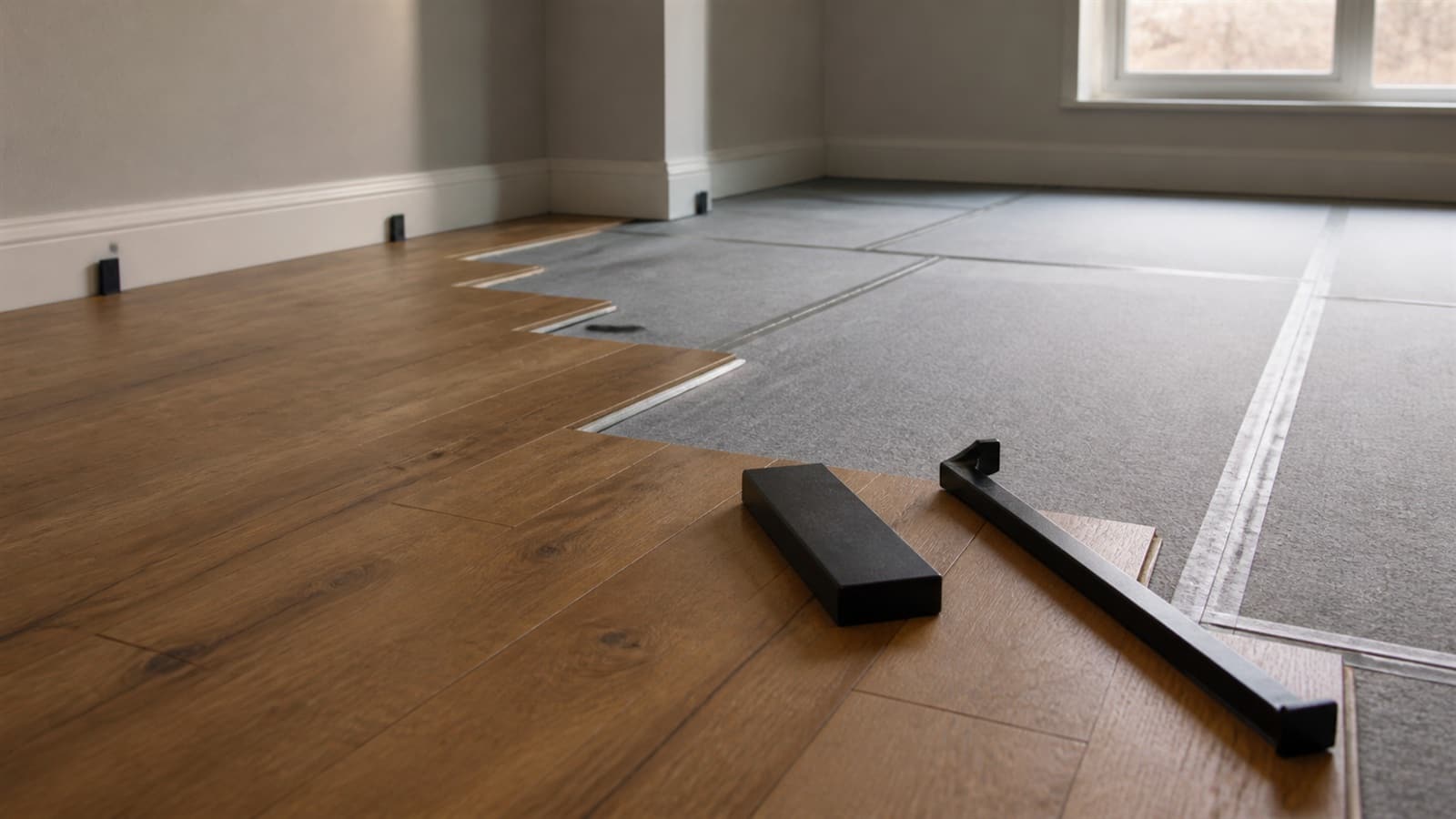
Laminate is a printed wear layer over a dense core, laid as a floating floor that is not fixed down to what is underneath it. It is the least expensive way to get a hard, wood looking floor into a room quickly.
A laminate plank is a high density fibreboard core with a photographic layer on top showing a wood grain, protected by a clear wear layer. The planks click together at the edges and rest on the subfloor rather than being nailed or glued to it, which is what floating means.
The wear layer is genuinely tough. Laminate resists scratching and denting better than most real wood, which is why it ends up in hallways, kids' rooms and anywhere a floor takes a beating.
The thing to be clear about is that it is not wood, and it can never be sanded or refinished. When a laminate floor wears out, it is replaced rather than restored. That trade is the whole proposition: less money now, a shorter life, and no maintenance in between.
Because the floor floats, everything it sits on is felt through it. A flat subfloor is not optional here. Dips let the planks flex, and flexing works the clicked joints apart until they gap or break.
Underlayment does three jobs. It takes out very small irregularities, it quietens the hollow sound a floating floor otherwise makes, and over concrete it carries a moisture barrier. Some planks come with a pad already attached, in which case a second layer is not added.
Over a concrete slab a moisture barrier is not a nice extra. Concrete gives off moisture for a long time, and a fibreboard core that absorbs it swells irreversibly. That is the failure that ends laminate floors early, and it is entirely preventable.
Three floors that look similar in a showroom and behave very differently in a house.
Hardest surface of the three and the cheapest. Handles scratches and dents well. Water is its weakness, because the core swells if water reaches it and stays. Best in dry rooms that take heavy use.
Waterproof the whole way through, softer and quieter underfoot, and fine below grade. Dents more easily than laminate. The right answer for kitchens, bathrooms and basements.
Costs the most and lasts the longest, because it can be refinished rather than replaced. Adds value in a way the other two do not. Wants a stable, dry environment above grade.
A common and sensible arrangement in a Staten Island house is wood on the main floor, laminate or vinyl in the basement and utility rooms, and vinyl anywhere plumbing runs.
Old covering out, then the subfloor checked for flatness and, over concrete, for moisture. Anything out of tolerance is levelled before the underlayment goes anywhere.
Laid across the whole area with the moisture barrier where one is needed, seams taped, and no overlaps that would create ridges.
Direction set to the longest run or the main light, joints staggered so the pattern does not repeat, and an expansion gap left at every wall, doorway and fixed object. A floating floor must be free to move or it will lift.
Beading or reinstated skirting covers the expansion gap, thresholds go in at doorways, and doors are trimmed where the new floor sits higher.
Tell us the rooms and what is down now, and we will say whether laminate or vinyl is the better fit.
Call (929) 207-0785Yes, in almost every case. An underlayment evens out very small irregularities in the subfloor, cuts the hollow sound a floating floor makes, and adds a little insulation underfoot.
Over a concrete slab it also has to include a moisture barrier, or a separate barrier goes down first. This is the one that matters most, because moisture rising out of concrete into a fibreboard core is what destroys laminate floors early.
The exception is a plank that already has a pad bonded to its underside. Those do not get a second layer, because doubling up makes the floor too soft and the joints work loose.
Waterproof throughout, and the right answer wherever water is a genuine risk.
Costs more, lasts far longer, and can be refinished rather than replaced.
If there is real wood under your current covering, bringing it back often beats replacing it.
Tell us the rooms and roughly the area, and we will talk through whether it is the right floor for them.